
INTERVIEW WITH SYLVIA ROUSS BY STORYBOOK LADY APRIL 24, 2026
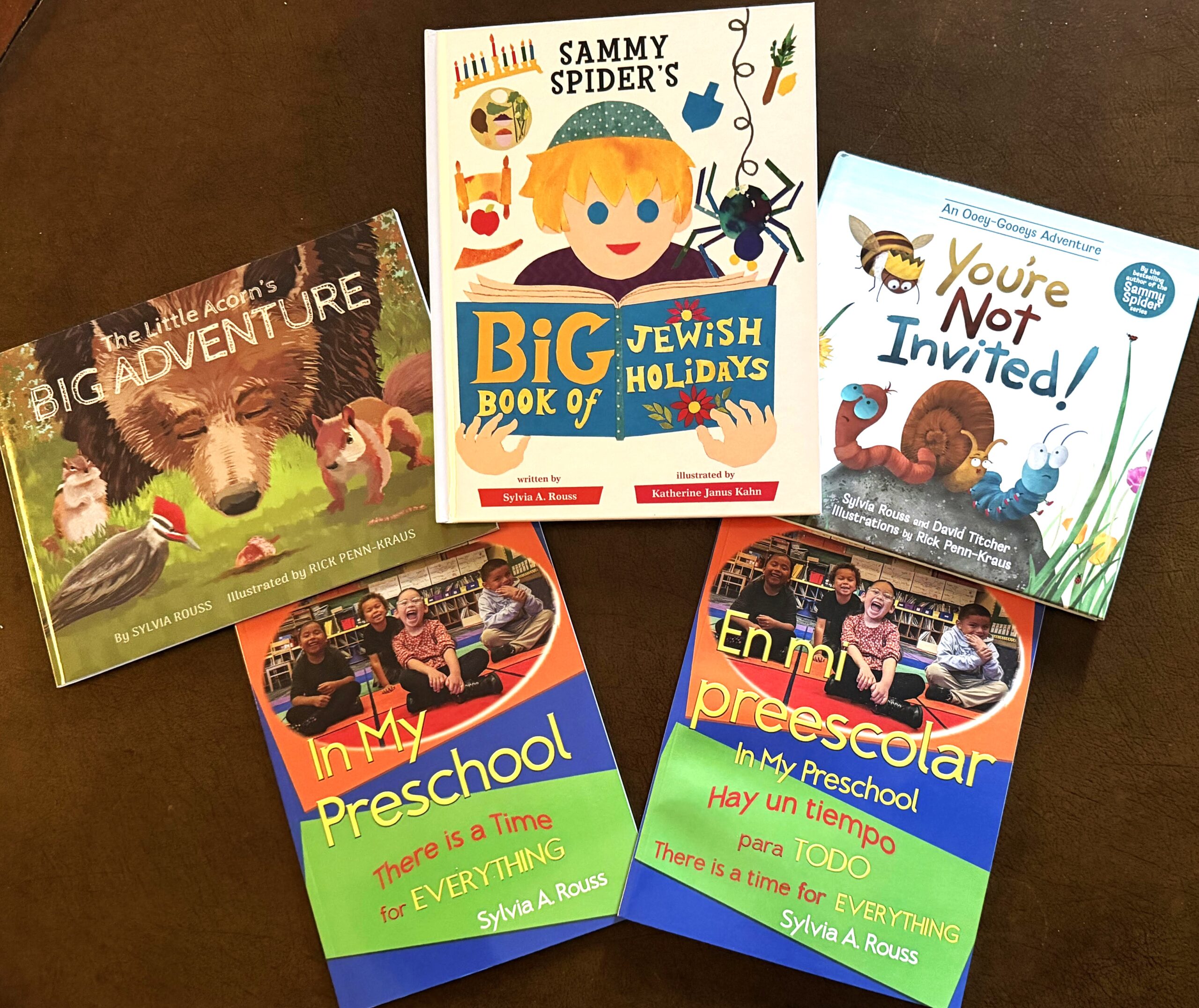
Sylvia Rouss is best known for her Sammy the Spider series, and I have been a fan since my children were little. She published her most recent Sammy book last year, but she has also recently written about preschool, bugs in a garden and a little acorn. I am excited to interview her about those books. Sylvia is an award‑winning early childhood educator and the author of more than 60 children’s books. She is best known for her beloved Sammy Spider series, which has lasted over 30 years and is now up to 30 different books. Sammy Spider and the Littlest books series, are both designed to introduce young readers to Jewish holidays and values in a fun and accessible way. In recent years Sylvia has written several general interest picture books that will appeal to any child. Sylvia, thank you for taking time for this interview. You have been quite fortunate and published several books in the past few years. With Arbor Day, tomorrow, I wanted to discuss your new book about trees.
The Little Acorn’s Big Adventure

Little Acorn’s Big Adventure
Q The Little Acorn’s Big Adventure, relates the life cycle of an oak tree in a way that little kids can relate to. What was the story seed that gave growth to this book?
A As a teacher, I always enjoyed taking my students on “nature walks” and observing the world through their eyes. Children are often captivated by the grandeur of trees, noticing details that adults may overlook. Equipped with magnifying glasses, they would closely examine the rough bark, marvel at its cracks and crevices, and get excited when they spotted insects crawling along the trunk. They collected fallen leaves, acorns, and pinecones, fascinated by the colors and patterns of leaves and the textures of acorns and pinecones. Their curiosity led us to research trees, where we discovered that trees can live for hundreds or even thousands of years. Additionally, trees are essential to ecosystems, providing food and shelter for both animals and humans. Through our research, we also found that trees hold significant meaning in many cultures and religions. One memorable discovery was a Talmudic quote: “There is no plant without an angel in heaven tending it and telling it, ‘Grow!’” Inspired by these experiences and findings, a story began to form in my mind. The resulting book uses minimal text and poetic rhythm to capture nature’s subtleties, and it was only recently that I decided to submit it for publication.
Q This book is different in style and content from your usual animal stories. It is comprised of short sentences that tell what happens to the acorn as opposed to a story with cute characters. Why did you choose this approach?
A I wanted to create a story based on reality. Consequently, I did not anthropomorphize the animals. The main character in this story is nature. The limited text allows nature to speak to us quietly through a poetic cadence. We see the wonders of nature unfold as each animal becomes an integral part of the natural process as an acorn grows into a tree.

Q I notice that your illustrator, Rick Penn-Kraus also changed his style. This book has illustrations that almost look like oil paintings which invite the reader into the woods. His work on another of your books this year, You’re Not Invited is in a completely different style. Tell me about working with Rick.

A. Rick’s illustrations truly bring the story to life. I am deeply appreciative of his remarkable talent. The artwork on each page beautifully captures the intricacies and wonders of nature, and his illustrations alone can tell the story. I find myself drawn into his art, making me feel part of the depicted scenes. Rick’s ability to capture the magic of nature allows readers to experience it firsthand, and I am extremely pleased with the result.
Rick told me that on this project, the visuals are almost impressionistic, in a thick painterly way. He added that his “original sample submission pieces to the publisher almost looked like fingerprinting”, and we loved it. My text left Rick lots of room to interpret the scenes and action, which I love. Sometimes he came in close with the illustration, other times much further away. He always wants the reader to be surprised and intrigued when they turn the page.


You’re Not Invited

Q You’re Not Invited is more typical of your work. You have written a story about friendship, cooperation, and inclusion placed in a garden setting. It is an adorable story with three fun protagonists. Most authors choose cute furry animals to tell a children’s story. This time instead of your silly spider you chose three bugs! Tell me about the origin of this story.
A Although I realize that cute fuzzy animals are typically appealing to young children, I wanted to take a less typical approach because this story is about recognizing and appreciating our differences. I selected characters—a worm, a snail, and a centipede—that children might find frightening or disgusting. Likewise, these characters face rejection in the garden they inhabit because they don’t have wings or six legs like the insects living there. The story reveals that the characters were initially misjudged, emphasizing the value of diversity and the unique contributions everyone has to offer.
Sammy Spider’s Big Book of Jewish Holidays

Q You are most famous for your Sammy Spider series. The first one was Sammy Spider’s First Hanukkah in 1993, and last year you published Sammy Spider’s Big Book of Jewish Holidays, the 25th Sammy Spider title. That little arachnid has been entertaining children for over three decades. What inspired Sammy?
A As a Jewish Early Childhood Educator, I discovered that each year when Hanukkah approached, the children in my class were also talking about Christmas. Of course, the children found many aspects of Christmas exciting. Not only were the local shops decorated in the colors of the season, but television had cartoons about Frosty the Snowman and Rudolph the Red Nosed Reindeer among others. It occurred to me that maybe I could create a Hanukkah character that would engage children. Just as Jewish children are sometimes the observers of a holiday that isn’t theirs, I wanted my character to be the outsider who sees the beauty of a Jewish holiday celebration he can’t be a part of. I decided on a spider because spiders have eight legs, and Hanukkah is celebrated for eight nights. In the Hanukkah story Sammy Spider watches a young family, the Shapiros (the last name of my school director at the time), celebrate Hanukkah. When he sees the young boy spin a dreidel, Sammy wants to join in. Unfortunately, Sammy Spider’s mother tells him, “Spider’s don’t spin dreidels. Spiders spin webs.” The book gained popularity with children and their parents and soon my publisher asked me to write other Sammy Spider Jewish holiday books.
In My Preschool / En mi prescolar


Q I know that you started your Career as a preschool teacher. In 2023, you came full circle and wrote a nonfiction book about preschool. Now this year, there is a Spanish edition. Tell us about that book.
A. I wrote In My Preschool for my youngest grandchildren as they were starting preschool. Like so many children, they were filled with both excitement and uncertainty as they began the process of leaving their parents to go to school. Using the verse from Ecclesiastes which explores the cycle of life, I decided to write a book that explores the daily cycle of preschool activities. I believed this would address and validate the ambivalence a young child might feel about starting school. To lend reality to the process, I chose to depict a diverse preschool that represents the community my grandchildren live in. There are many Spanish speaking children in this community so it made sense to create a new bilingual edition.
The Next Chapter
Q You had three books published in 2025. This year saw the new bilingual edition of In My Preschool. But can we expect any new books from you this year? What do you have in the pipeline?
A. I have written a story about a contemporary adaptation of the imaginary village of Chelm inhabited by extremely foolish people who consider themselves to be very wise. The idea was inspired by historical tales found in Jewish, German, and English literature. These humorous stories focus on how the villagers devise the most absurd solutions to any problem. Through my research, I found these stories to be both funny and charming. Although they were originally intended for adults, I chose to create a version that would be entertaining for young children. I am currently seeking a publisher for this manuscript.
TO READ MORE FROM THE STORYBOOK LADY, CLICK HERE